Reports suggest the USS Abraham Lincoln repositioned as tensions rise after Iranian missile threats during the expanding U.S.–Israel confrontation with Iran.
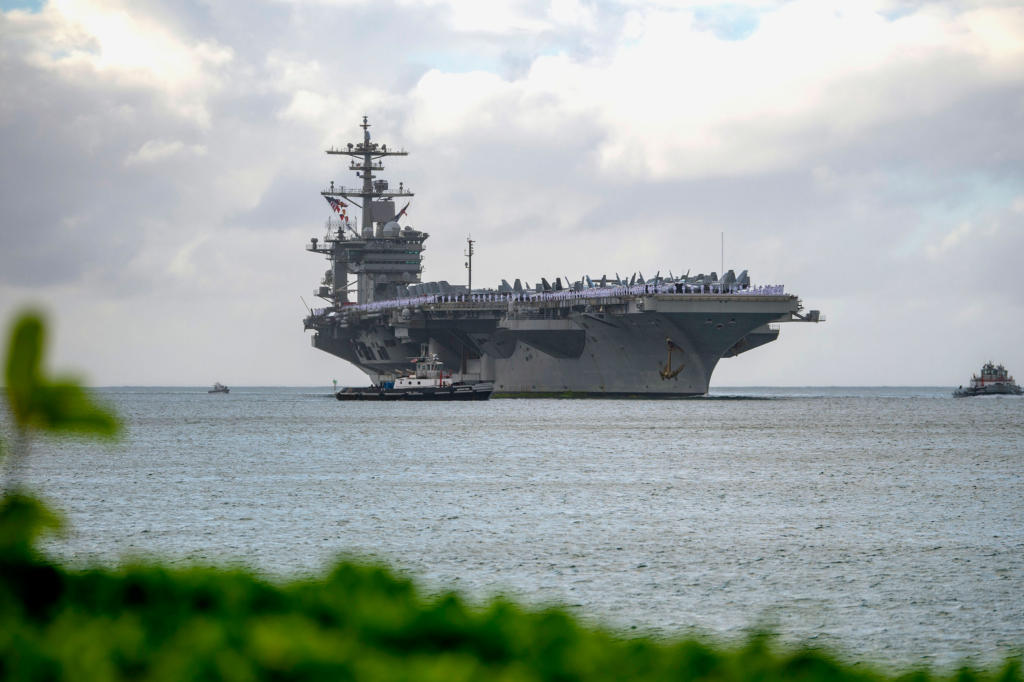
The escalating military confrontation between the United States, Israel, and Iran has raised global security concerns, with new reports suggesting that American naval forces in the Middle East may have repositioned strategic assets due to potential ballistic missile threats. According to regional reports and statements cited by Russian and British sources, the U.S. aircraft carrier USS Abraham Lincoln (CVN-72) was reportedly moved farther from Iranian waters as tensions intensified following Iranian missile warnings and retaliatory strikes.
The development comes amid an expanding military campaign in the region after joint U.S.–Israeli strikes targeted Iranian military infrastructure earlier this year. The aircraft carrier strike group led by the USS Abraham Lincoln had been deployed to the Middle East as part of a broader American military buildup intended to deter Iran and support ongoing operations. The carrier arrived in the region in January 2026 with a full strike group, including guided-missile destroyers, cruisers, and advanced fighter aircraft such as F/A-18 Super Hornets and F-35C stealth jets.
However, the situation escalated sharply when Iran’s Islamic Revolutionary Guard Corps (IRGC) claimed it had launched ballistic missiles targeting the USS Abraham Lincoln during a retaliatory operation. Iranian state media reported that four missiles were fired toward the carrier as part of a broader campaign against U.S. and Israeli military assets in the region.
Despite these claims, the United States Central Command (CENTCOM) strongly denied that any Iranian missiles struck the carrier. American officials stated that the missiles “did not even come close” to hitting the ship and emphasized that the USS Abraham Lincoln continued to operate normally and launch aircraft for ongoing military operations.
The conflicting narratives between Tehran and Washington highlight the ongoing information war accompanying the military confrontation. While Iranian officials presented the missile launches as proof of their ability to threaten U.S. naval assets, American military leaders insisted that the carrier strike group remains fully operational and capable of defending itself against missile and drone attacks.
Nevertheless, analysts say the potential risk posed by Iranian anti-ship ballistic missiles remains significant. Iran has spent years developing specialized weapons designed to target large naval vessels, including aircraft carriers. One such system is the Hormuz-1 anti-radar ballistic missile, which is reportedly capable of striking radar systems and naval targets at distances of around 300 kilometers and traveling at speeds of up to Mach 5.
Because aircraft carriers are among the most valuable and visible assets in the U.S. military, commanders typically maintain operational flexibility by repositioning them to reduce risk while still allowing aircraft to conduct missions. Strategic movement of naval forces is common during conflicts and does not necessarily indicate a retreat but rather a tactical adjustment to evolving threats.
The broader military context also underscores the seriousness of the confrontation. Since late February 2026, the United States and Israel have conducted a large-scale military campaign targeting Iranian missile sites, drone facilities, and other strategic infrastructure. According to reports, the campaign has involved hundreds of airstrikes and naval operations aimed at weakening Iran’s military capabilities.
The conflict has already resulted in casualties and widespread regional instability. Several U.S. service members have reportedly been killed during operations, while Iranian retaliatory strikes have targeted military bases and strategic locations across the Middle East.
In addition to military exchanges, the conflict has also intensified geopolitical tensions worldwide. Russia and several other countries have warned that continued escalation could trigger a broader regional war involving multiple actors. Energy markets have also been affected, with fears that the Strait of Hormuz—one of the world’s most important oil shipping routes—could become a flashpoint if hostilities continue.
For Iran, the missile launches serve both a military and symbolic purpose. Demonstrating the ability to threaten a U.S. aircraft carrier sends a powerful message about Iran’s missile capabilities and its willingness to challenge American military dominance in the region. For Washington, however, maintaining carrier presence in the region remains crucial for projecting power and supporting allied operations.
Military experts say aircraft carriers like the USS Abraham Lincoln are equipped with multiple layers of defense, including advanced radar systems, interceptor missiles, and escort ships designed to protect them from aerial and missile attacks. These defensive capabilities make carriers extremely difficult targets despite the increasing sophistication of modern missile technology.
As the confrontation continues, the movement of naval assets, missile exchanges, and escalating rhetoric between world powers illustrate how fragile the regional security environment has become. While both sides insist they are acting defensively, the risk of further escalation remains high.
The coming weeks will likely determine whether the conflict stabilizes through diplomatic pressure or expands into a larger war that could reshape the geopolitical landscape of the Middle East.