U.S. President Questions Status of Iran’s Supreme Leader Mojtaba Khamenei as Leadership Uncertainty Deepens
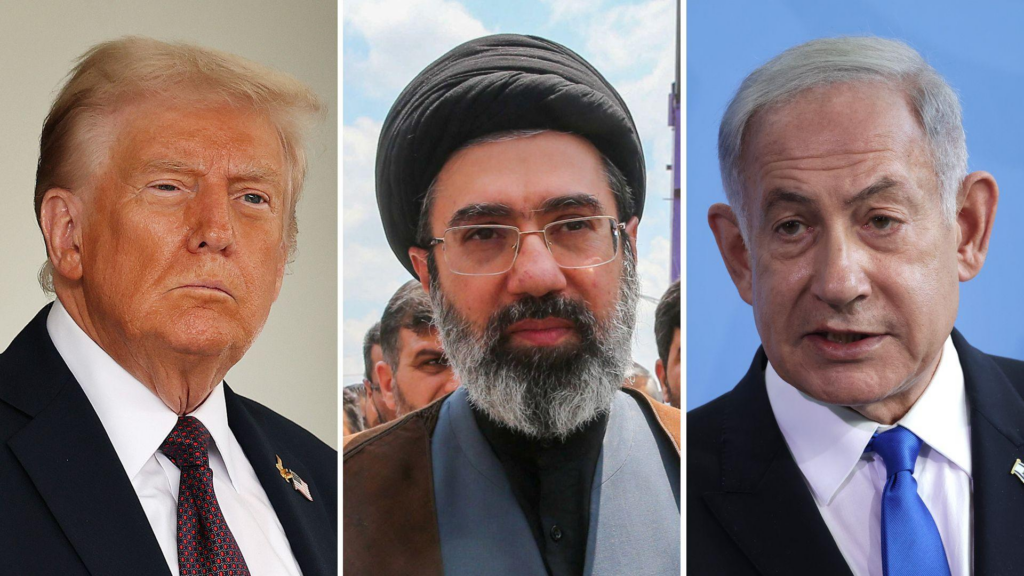
U.S. President Donald Trump has said it remains unclear whether Iran’s new supreme leader, Mojtaba Khamenei, is alive or dead, highlighting growing uncertainty surrounding the leadership of the Islamic Republic amid the ongoing regional conflict. Trump’s comments came during remarks in Washington where he acknowledged that U.S. officials have conflicting intelligence reports about the condition of Iran’s newly appointed leader following a series of intense airstrikes and military operations targeting Iranian infrastructure.
The leadership confusion emerged after the reported death of Iran’s longtime supreme leader Ali Khamenei earlier in the conflict, after which Iranian authorities moved to install his son Mojtaba Khamenei as successor. However, according to U.S. officials and intelligence assessments cited by Trump, the younger Khamenei may have been seriously wounded during recent strikes, and has not been seen publicly since the escalation began.
Speaking to reporters, Trump said the United States cannot confirm whether Mojtaba Khamenei is still alive, explaining that no clear evidence has emerged showing him publicly since the attacks. “Nobody’s seen him,” Trump reportedly said, adding that Washington is still trying to determine who currently holds authority inside Iran’s leadership structure.
Leadership Vacuum Raises Strategic Questions
The uncertainty over Iran’s leadership has created a potential political vacuum in Tehran, complicating diplomatic and military calculations in the region. U.S. officials have acknowledged that the absence of confirmed leadership makes it difficult to determine who could represent Iran in negotiations or potential ceasefire discussions.
According to reports, Pentagon officials previously indicated that Mojtaba Khamenei may have been injured during an earlier strike, with some intelligence suggesting severe wounds. However, Iranian authorities have not publicly confirmed any injuries or death, leaving the situation unclear.
Analysts say that if the leader were incapacitated or killed, Iran’s political system could face internal power struggles among clerical elites, Revolutionary Guard commanders, and government officials, potentially destabilizing the country’s chain of command during wartime.
Iran’s Political System and Succession
Iran’s supreme leader holds the highest authority in the Islamic Republic, overseeing the military, judiciary, state broadcasting, and key government institutions. The position traditionally carries enormous influence over both domestic and foreign policy.
Under Iran’s constitutional framework, the Assembly of Experts, a body of clerics, is responsible for appointing and supervising the supreme leader. In moments of leadership crisis, the council may select a new leader or establish a temporary governing council until a permanent successor is confirmed.
The appointment of Mojtaba Khamenei following his father’s death was already considered controversial by some analysts because it marked a rare instance of familial succession in Iran’s revolutionary system, which historically sought to avoid hereditary leadership structures.
Impact on the Ongoing Conflict
The confusion surrounding Iran’s leadership comes at a time when tensions between Iran and its adversaries remain extremely high. Military strikes, drone attacks, and missile exchanges across the Middle East have significantly escalated the conflict, drawing in multiple regional actors and raising fears of a wider war.
Trump suggested that the uncertainty about Iran’s leadership could affect future negotiations, saying Washington does not yet know who it could speak with on Iran’s side if diplomatic talks were to begin.
Some analysts believe that if Iran’s leadership structure becomes unstable, it could lead to more aggressive actions by regional military factions, particularly those affiliated with the Islamic Revolutionary Guard Corps (IRGC), which plays a major role in Iran’s defense and strategic operations.
International Reactions
International observers are closely monitoring developments, as the stability of Iran’s leadership could influence the trajectory of the broader Middle East conflict. Western governments have expressed concern about potential escalation if command structures inside Iran become fragmented or unclear.
Diplomatic efforts from regional mediators have reportedly attempted to open communication channels with Tehran, but the uncertainty over leadership has complicated those initiatives.
For now, Trump’s statement underscores the ongoing intelligence gap regarding Iran’s political leadership, leaving global observers watching closely for any public appearance or official confirmation regarding Mojtaba Khamenei’s status.