France’s restriction on race data limits bias statistics, rights chief says, citing a 2024 survey of 5,000
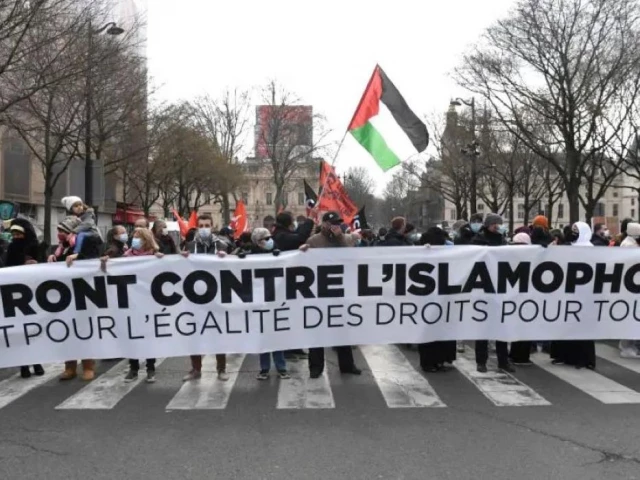
Discrimination based on religion has escalated in France, according to a report released Thursday by the country’s rights ombudswoman, with one in every three Muslims surveyed reporting having experienced it.
France has a sizable Muslim population thanks to immigration from its former colonies, especially North Africa.
French legislation prohibits the collection of data on a person’s race, ethnicity, or religion, making it difficult to compile comprehensive statistics on discrimination.
However, the office of rights chief, Claire Hedon, highlighted a 2024 study of 5,000 individuals who are representative of France’s population.
Seven percent of individuals polled claimed they had faced religious prejudice in the previous five years, up from 5% in 2016, the report stated.
The rate was higher among people of Muslim descent.
Up to 34% of Muslims — or those thought to be Muslims — reported discrimination, compared to 19% for other religions such as Judaism and Buddhism and only 4% for Christians.
The percentage among Muslim women was 38%, compared to 31% for their male counterparts.
The report stated that discrimination could lead to exclusion, particularly for Muslim women who wear headscarves.
“Stigmatised in public spaces, they face restrictions on their careers,” it reads.
It stated that they may be compelled to give up occupations, accept positions for which they are overqualified, or turn to community companies or self-employment if they are unable to find work, and that they were sometimes barred from participating in sports.
‘Incorrect interpretation of secularism.’
French secularism arose from a 1905 law that protected “freedom of conscience,” separated religion and state, and guaranteed the state’s neutrality.
However, in recent years, it has been used to justify bans on conspicuous religious symbols such as the Muslim headscarf in some contexts, such as state schools.
Some French Muslims fear the society is becoming increasingly unfriendly, particularly as the right and far right in mainstream media warn of “Islamist encroachment” following the country’s worst jihadist atrocities in Paris in 2015.
According to the paper, almost one-fourth of those polled in another study misinterpreted French secularism to entail “a ban on religious symbols in public spaces,” which was “an incorrect interpretation.”
It stated that “a gap between social perception and the reality of the legal framework” was most likely linked to an increasingly secular society, but it also reiterated “political and media discourses”.
It urged for more education on French secularism, claiming that legislative actions commonly cited as combating religious segregation, such as prohibiting women from wearing headscarves in specific circumstances, instead “contribute to fostering it”.
Rights groups and activists have claimed that outlawing headscarves still amounts to ordering a woman what to wear rather than giving her the opportunity to choose for herself.