Mamdani’s remarks spark national debate over foreign policy, war powers and public safety after President Trump announces military action
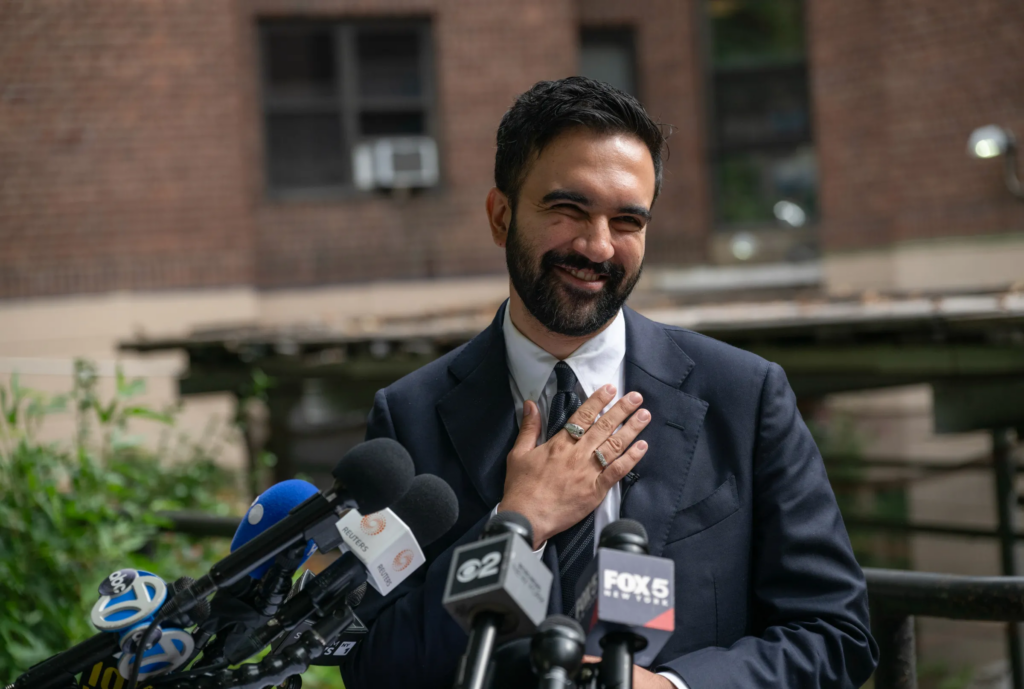
Shortly after former President Donald Trump confirmed that the United States and Israel carried out military strikes on Iran, New York City Mayor Zohran Mamdani issued a forceful public response condemning the action, calling it a “catastrophic escalation in an illegal war of aggression” and igniting a broader debate about U.S. foreign policy, war powers, and community safety. Mamdani’s remarks, shared via social media and amplified by national media outlets, reflect deep divisions within American political discourse over the role of military force and diplomatic restraint.
On February 28, 2026, President Trump announced that U.S. and Israeli forces had launched coordinated strikes against Iranian targets — a move that followed Iran’s increasingly hostile posture and missile exchanges with Israel and Gulf states. In the early hours after the announcement, Mamdani took to his official X (formerly Twitter) account to express opposition to the strikes, describing the bombing as an illegitimate expansion of violence and placing responsibility on the administration’s decision to pursue military action rather than diplomacy. “Today’s military strikes on Iran — carried out by the United States and Israel — mark a catastrophic escalation in an illegal war of aggression,” he wrote. “Bombing cities. Killing civilians. Opening a new theater of war.”
Mamdani’s emphatic language — particularly the framing of the strikes as an “illegal war” — has made him one of the more outspoken critics of the federal government’s approach among U.S. elected officials. While many local leaders, including New York Governor Kathy Hochul, have stressed heightened security measures at home and the need for congressional authorization before engaging in foreign conflict, Mamdani went further by directly challenging the strategic rationale for the military action and its potential human cost.
Critics have not held back in their response. Conservative commentators and public figures have accused Mamdani of undermining national security and inadvertently defending Tehran’s regime, even as others argue his stance highlights legitimate concerns about civilian casualties and the broader repercussions of foreign intervention. Some opponents have criticized him for speaking out on international matters as a city mayor, asserting that his priority should be local governance rather than commenting on global military strategy.
In addition to condemning the military action, Mamdani framed his argument around domestic priorities. He wrote that “Americans do not want this” and emphasized that U.S. citizens are more concerned with issues like economic affordability and peace than extended overseas engagements. “They want relief from the affordability crisis. They want peace,” he stated, echoing broader public opinion polls showing skepticism toward large‑scale foreign conflicts without clear objectives.
Mamdani has also sought to reassure New Yorkers, particularly those from Iranian heritage or other Middle Eastern backgrounds, of their safety. In subsequent statements, he highlighted his administration’s coordination with law enforcement and emergency management officials to protect the city’s vulnerable and symbolic sites, emphasizing that there are “no credible threats to NYC” at this time despite regional instability.
Despite his sharp critique of U.S. and Israeli military strategy, Mamdani has also remarked critically on the Iranian regime’s domestic record, describing it as “brutal” and repressive toward its own people. He noted that Iran’s government has engaged in “systematic repression,” including violent crackdowns on dissent. This dual stance — condemning both external military action and authoritarian repression — places Mamdani in a nuanced position: opposed to war yet critical of Tehran’s human rights record.
Nationally, Mamdani’s comments have fanned debates not only about war and peace but also about constitutional authority. Some lawmakers and commentators argue that any prolonged or large‑scale military engagement should require Congressional approval under the U.S. Constitution’s War Powers Clause. Critics of the strikes have urged debates and potential resolutions to rein in executive military authority, pointing to historical conflicts like Iraq and Afghanistan as cautionary examples of prolonged engagement without clear legislative backing.
Supporters of the strikes, on the other hand, argue that swift military action was necessary to preempt further threats from Iran — particularly in light of Tehran’s expanding missile capabilities and recent regional hostilities. They assert that confronting Tehran’s military posture may be critical for long‑term U.S. and Israeli security, even if the decision comes under scrutiny from domestic critics. These differing viewpoints illustrate how deeply the issue of foreign policy has fractured contemporary political debate in the United States.
Ultimately, Mamdani’s response highlights how local leaders can shape national conversations, especially when global events resonate deeply with their constituents. As the Middle East conflict unfolds and diplomatic and military strategies continue to shift, criticisms from figures like Mamdani will contribute to the wider dialogue about American involvement abroad — and whether the path chosen today aligns with public sentiment and constitutional norms.