Attack in Beirut’s Dahiyeh District Raises Fears of Escalation Between Israel and Hezbollah
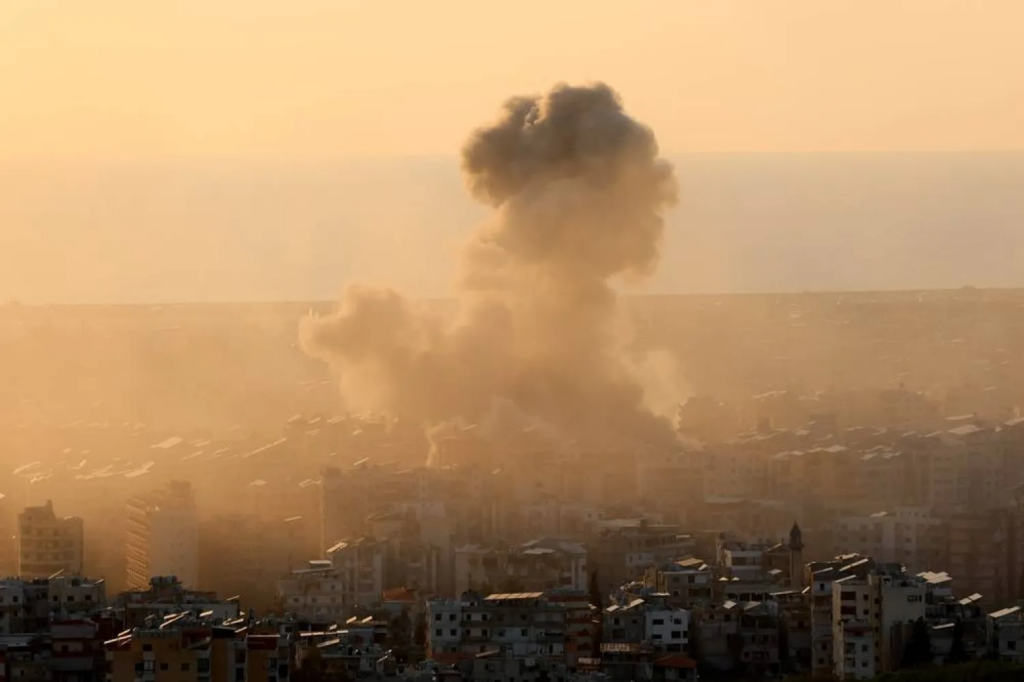
An airstrike attributed to Israel has reportedly targeted the southern suburbs of Beirut, intensifying concerns about a broader escalation of hostilities in the Middle East. The strike reportedly hit areas within Dahiyeh, a densely populated district in the Lebanese capital that is widely known as a stronghold of the militant group Hezbollah.
According to initial reports from regional media and security sources, loud explosions were heard across multiple neighborhoods in Beirut’s southern suburbs late at night. Residents described seeing flashes in the sky followed by powerful blasts that shook buildings and sent smoke rising above the city skyline. Emergency responders and civil defense teams were quickly dispatched to the affected areas to assess damage and search for possible casualties.
The southern suburbs of Beirut have long been considered one of the most sensitive areas in Lebanon’s security landscape. Dahiyeh hosts residential districts, commercial centers, and infrastructure linked to Hezbollah, which maintains a strong political and military presence in the area. Because of this association, the district has historically been targeted during conflicts involving Israel and Hezbollah.
Israeli officials have not immediately provided detailed confirmation about the strike, but analysts say such operations are typically aimed at military infrastructure, weapons storage facilities, or command centers believed to be connected to Hezbollah’s operations. Israel has repeatedly warned that it will continue targeting locations used to store missiles, drones, or advanced weapons systems that could threaten Israeli territory.
Hezbollah, which is backed by Iran, has been one of Israel’s most formidable adversaries for decades. The group possesses a significant arsenal of rockets and missiles and has engaged in multiple rounds of conflict with Israel, including the major war in 2006 that caused widespread destruction across Lebanon and northern Israel.
The latest strike comes amid heightened tensions across the region, where military confrontations have expanded beyond traditional battle lines. In recent months, the Middle East has witnessed a surge in drone attacks, missile launches, and cross-border military operations involving multiple actors. Analysts warn that incidents such as the Beirut airstrike risk pushing the region closer to a wider conflict.
Local residents in Beirut’s southern suburbs reported scenes of panic following the explosions. Some families fled their homes while others gathered in streets and balconies attempting to determine the source of the blasts. Videos posted on social media showed thick smoke rising from buildings while emergency vehicles rushed through nearby streets.
Lebanese security forces and emergency services quickly sealed off several streets in the affected area as rescue operations began. Civil defense teams were seen searching damaged buildings and clearing debris, while ambulances transported injured individuals to nearby hospitals. Authorities have not yet released official casualty figures, though reports indicate that several people may have been wounded in the strike.
Lebanon’s government has condemned previous Israeli operations on its territory and has repeatedly called for international intervention to prevent further attacks. Officials argue that such strikes violate Lebanese sovereignty and risk destabilizing the already fragile security environment in the country.
International observers have also expressed concern about the potential consequences of repeated strikes in urban areas. Beirut is one of the most densely populated cities in the Middle East, and military operations within or near residential districts can increase the risk of civilian casualties and infrastructure damage.
Defense analysts note that Israel has increasingly relied on precision airstrikes and intelligence-based targeting to disrupt weapons transfers and military activities linked to Hezbollah and other Iranian-backed groups in the region. These operations are often designed to prevent the buildup of missile capabilities that could threaten Israeli cities.
At the same time, Hezbollah has continued to expand its military capabilities over the past decade. Intelligence estimates suggest the group possesses tens of thousands of rockets and missiles, many of which are capable of reaching deep into Israeli territory. This capability has been a central factor shaping Israel’s military strategy in Lebanon.
The latest strike in Beirut’s southern suburbs therefore carries both military and political significance. While Israel may view such operations as necessary to maintain its security, each attack also increases the risk of retaliation and broader escalation.
Regional diplomacy has struggled to contain tensions between Israel and Hezbollah. International mediators have repeatedly urged both sides to exercise restraint and avoid actions that could trigger a full-scale war similar to the devastating conflict seen in 2006.
For residents of Beirut’s southern suburbs, however, the immediate concern remains safety and recovery from the latest strike. Emergency crews continue to work in affected areas to assess structural damage, restore electricity in some neighborhoods, and provide aid to those displaced by the explosions.
As investigations continue and more information becomes available, the strike on Beirut’s southern suburbs is likely to become another key flashpoint in the evolving security situation across the Middle East. With regional tensions already running high, analysts warn that even a single incident could have far-reaching consequences for stability in Lebanon and beyond.