Explosions Reported Near Israel–Lebanon Border as Military Activity Intensifies in Conflict-Prone Region
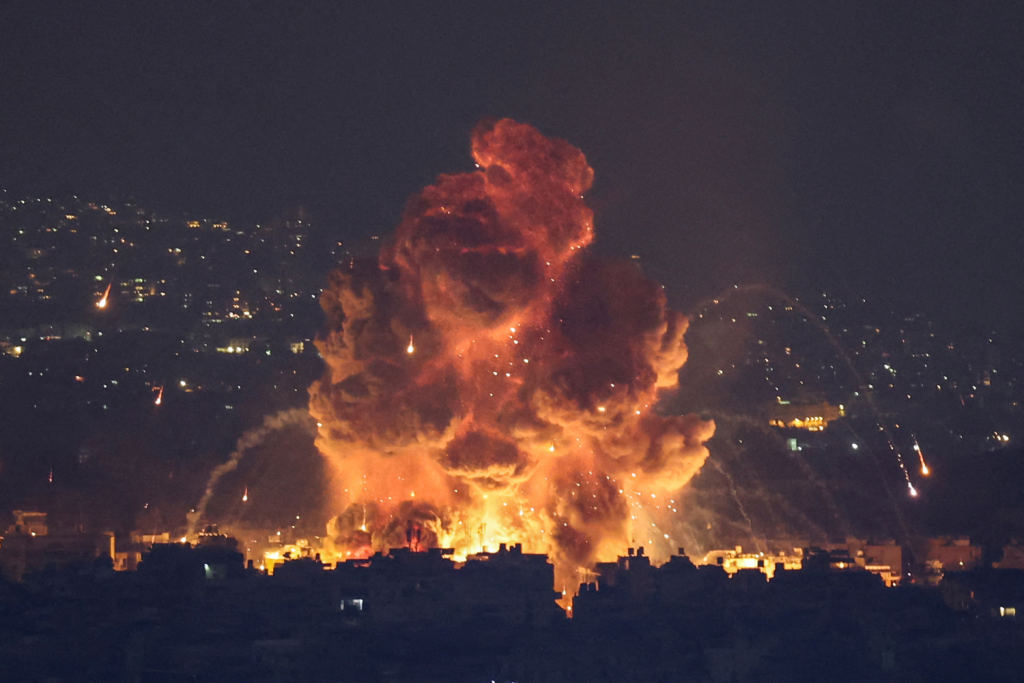
Three airstrikes attributed to Israel have reportedly hit areas in Southern Lebanon, marking another escalation in the ongoing tensions along the volatile border between Israel and Lebanon. According to regional reports and security sources, the strikes targeted multiple locations across the southern part of the country, a region that has frequently been the focus of cross-border confrontations between Israeli forces and the Lebanese militant group Hezbollah.
Residents in several towns across southern Lebanon reported hearing loud explosions late at night, followed by the sound of aircraft flying over the area. Witnesses described flashes in the sky and columns of smoke rising from locations believed to have been struck during the operation. Emergency responders and local civil defense teams were dispatched to the affected sites to assess damage and check for casualties.
Southern Lebanon has long been considered one of the most sensitive and heavily monitored security zones in the Middle East. The region lies directly along the border with Israel and has historically served as a frontline area during conflicts between Israeli forces and Hezbollah fighters. Since the end of the 2006 war between Israel and Hezbollah, the border has remained tense, with periodic exchanges of fire and military operations occurring on both sides.
While Israeli officials have not immediately released detailed statements about the latest strikes, analysts say such operations typically target military infrastructure, weapons storage facilities, or positions believed to be used by Hezbollah fighters. Israel has repeatedly warned that it will take action to prevent the transfer or deployment of advanced weapons systems that could threaten Israeli territory.
Hezbollah, which maintains both political influence and a large military force within Lebanon, has built a significant network of defensive positions in southern parts of the country. Intelligence estimates suggest the group possesses thousands of rockets and missiles capable of reaching cities across Israel. As a result, Israel closely monitors the region and has conducted numerous airstrikes over the years aimed at disrupting Hezbollah’s military capabilities.
The reported airstrikes also come at a time when tensions across the Middle East remain extremely high. Several regional conflicts and military confrontations have raised fears that localized clashes could escalate into a broader war involving multiple countries and armed groups. Cross-border attacks, missile launches, and drone operations have all increased in frequency, contributing to an unstable security environment.
Local residents in southern Lebanon described scenes of fear and uncertainty after the explosions. Some families reportedly left their homes temporarily while others gathered in open areas to observe the aftermath of the blasts. Videos circulating on social media appeared to show smoke rising from hills and valleys in the region, though the exact locations of the strikes have not yet been independently verified.
Lebanese authorities have previously condemned Israeli air operations within their territory, describing them as violations of national sovereignty. Government officials often call on the international community to pressure Israel to halt such strikes and respect Lebanon’s borders. However, diplomatic efforts to prevent cross-border military incidents have had limited success in recent years.
The situation along the Israel-Lebanon border is also monitored by the United Nations Interim Force in Lebanon (UNIFIL), a peacekeeping mission deployed in southern Lebanon to help maintain stability after the 2006 conflict. UNIFIL patrols the border area and coordinates with both Lebanese and Israeli authorities to prevent misunderstandings or unintended escalations. Despite these efforts, occasional clashes and military operations still occur.
Military analysts note that southern Lebanon’s geography plays a key role in its strategic importance. The region’s hills, valleys, and villages provide natural cover for defensive positions and weapons storage sites. This terrain has historically complicated military operations and made it difficult to eliminate militant infrastructure without risking damage to nearby civilian communities.
Another concern raised by experts is the risk of miscalculation. When multiple airstrikes occur in a short period of time, there is always the possibility that the opposing side may respond with retaliatory rocket attacks or cross-border operations. Such responses can quickly escalate into wider confrontations if both sides increase military pressure simultaneously.
For civilians living in southern Lebanon, these recurring incidents create ongoing uncertainty. Many communities in the region have experienced repeated conflicts over the past decades, leading residents to remain cautious whenever reports of airstrikes or military movements emerge. Emergency services in the area often operate under difficult conditions, responding quickly to explosions while also ensuring the safety of rescue teams.
At this stage, details regarding casualties or the full extent of damage from the three reported airstrikes remain limited. Authorities are continuing to assess the affected areas while security forces monitor the border for potential further developments.
As tensions continue across the Middle East, the situation in southern Lebanon remains one of the region’s most closely watched flashpoints. The reported airstrikes serve as another reminder of how fragile stability along the Israel-Lebanon border remains and how quickly localized incidents can influence the broader geopolitical landscape.
With diplomatic channels struggling to ease tensions and military operations continuing in various parts of the region, observers warn that the coming weeks could prove critical for preventing further escalation between Israel, Hezbollah, and other regional actors.