Claudia Sheinbaum considers legal action after Elon Musk suggested she acts at the behest of Mexican drug cartels, prompting sharp political reactions amid ongoing cartel violence.
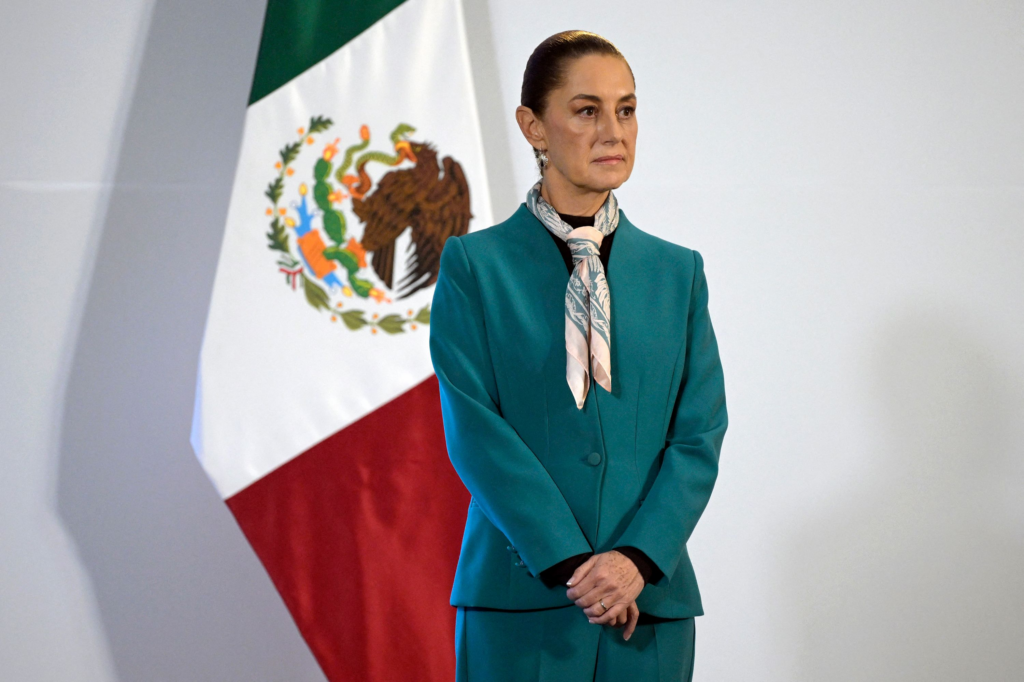
Mexican President Claudia Sheinbaum announced on February 24, 2026 that her government is considering legal action against tech billionaire Elon Musk after he made highly controversial remarks on the social media platform X (formerly Twitter), accusing her of acting like a “puppet” for drug cartels — a claim she and her administration strongly reject as unfounded and harmful.
The dispute arose shortly after the killing of Nemesio “El Mencho” Oseguera Cervantes, leader of the powerful Jalisco New Generation Cartel (CJNG), by Mexican security forces in an unprecedented military operation. Oseguera’s death triggered a wave of cartel-related violence in several Mexican states, rekindling domestic and international debate over Mexico’s security strategy and government response to organized crime.
The Musk Post That Sparked Outrage
Elon Musk, the CEO of SpaceX and owner of X, reacted to a 2025 video clip of President Sheinbaum discussing cartel violence and rejecting a return to a militarized “war on drugs.” In that clip, Sheinbaum argued that fighting cartels through open warfare — a tactic once pursued by past administrations — would be outside the law and potentially harmful to civilians.
Responding to that video on X, Musk wrote:
“She’s just saying what her cartel bosses tell her to say.”
This blunt characterization implied that Sheinbaum’s policy positions were dictated by cartel leaders rather than by the Mexican state — a suggestion the president vehemently disputes.
Sheinbaum’s Response: Legal Action Under Consideration
At her daily morning press conference on Tuesday, Sheinbaum confirmed that her legal team is reviewing the possibility of filing a lawsuit against Musk for his allegations, calling the accusations “absurd” and without basis. She said government lawyers are currently analyzing the issue and that any decision on legal action could come soon.
Sheinbaum emphasized that the primary concern of her administration is the safety, well-being and opinion of the Mexican people, rather than the disruptive commentary of social media figures. She also mocked the notion of a so-called “narcogovernment,” arguing that such claims fall apart under scrutiny and add nothing to the country’s efforts against organized crime.
Political and Social Fallout
The tension illustrates how cartel violence and political debate intersect in Mexico, where public frustration over insecurity remains acute. While Sheinbaum’s administration has taken a more assertive line against powerful criminal networks — notably through the military raid that killed El Mencho — social media commentary intertwined with political discourse can quickly inflame public perception.
Sheinbaum’s critics have previously suggested that her approach to cartel violence is too cautious, especially when compared with past “war on drugs” tactics. Supporters of the president argue that heavy-handed militarization has previously resulted in significant civilian casualties and destabilization without solving the underlying causes of cartel power. These competing views create fertile ground for sensational social media claims — like Musk’s — to spread rapidly.
Her party’s leadership also weighed in: Luisa Alcalde, head of the ruling MORENA party, criticized Musk, saying that rather than mischaracterizing Mexico’s leadership, influential tech figures should use their platforms to support efforts against drug consumption, disinformation, and narco-influence. Alcalde said that wealth does not equate to moral authority and stressed the importance of focusing on real policy solutions.
Cartel Violence and National Security Context
The backdrop to this controversy is a renewed battle against drug cartels in Mexico, where violence has soared for years. The Jalisco New Generation Cartel — whose leader’s death triggered recent unrest — is among the country’s most powerful and brutal criminal organizations, involved in drug trafficking, extortion and mass violence.
After the military operation killed El Mencho, loyalists staged attacks across several states, including road blockades and assaults on security forces. These events underscored the deep challenges Mexico faces in dismantling entrenched criminal syndicates and combating fragmentation within cartel networks.
The Mexican government insists that the strategic focus remains on lawful enforcement, intelligence-based operations, and protecting civilians, not launching an all-out war that could risk further destabilization. This stance, critics argue, can make leaders vulnerable to accusations, both domestically and internationally, especially when complex issues are simplified in social media commentary.
Implications for Mexico and Global Perception
The potential legal battle between Sheinbaum and Musk reflects broader concerns about the misuse of social media platforms to influence public discourse and spread unverified claims. It also highlights the responsibility carried by influential figures when commenting on sensitive geopolitical and security issues involving sovereign governments.
For Mexico, a lawsuit — if pursued — could set a precedent for how public officials respond to defamatory social media statements that intersect with national security narratives. Observers will be watching closely whether this dispute escalates into a legal confrontation with global implications for political speech and online accountability.