Military strikes target Iran’s Council of Experts amid leadership vacuum after Khamenei’s death, intensifying Middle East crisis
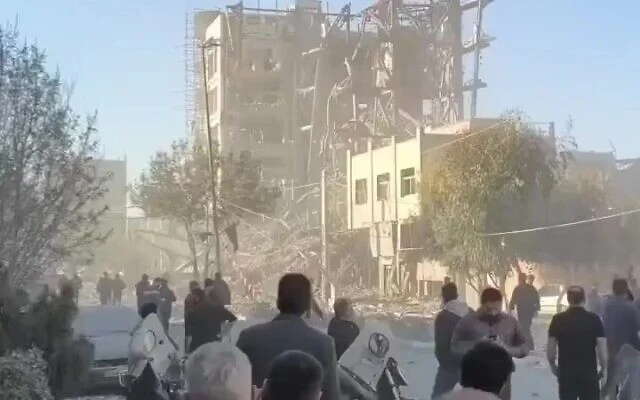
In one of the most consequential escalations of the ongoing Israel–Iran conflict of 2026, Israeli and U.S. military forces reportedly struck the building housing Iran’s Council of Experts in the holy city of Qom, a body constitutionally responsible for selecting the new Supreme Leader following the death of Ayatollah Ali Khamenei. According to multiple credible media sources and official military statements, the strike occurred at a critical moment when clerics were counting votes to determine Tehran’s next supreme authority — a dramatic move with far‑reaching geopolitical implications.
The Council of Experts is a powerful assembly of 88 senior Islamic clerics elected to oversee the Supreme Leader’s succession and provide doctrinal guidance. It is central to Iran’s political system, empowered under the constitution to appoint a new Supreme Leader when the position becomes vacant — a process historically rare and tightly controlled. In 2026, following Khamenei’s confirmed death from an Israeli‑U.S. airstrike in Tehran on 28 February, this council moved to convene for what should have been a formal succession process.
However, on 3 March 2026, the Israeli Air Force reportedly targeted the Qom assembly location during the vote count, striking the building and flattening parts of the complex. Axios reported that an Israeli defense official explicitly stated the attack was meant “to prevent [the clerics] from picking a new supreme leader.” It remains unclear how many council members were inside or the full extent of casualties, but the timing underscores a strategic objective to disrupt Iranian leadership continuity.
Iranian state outlets and local media described the assault as “an attack on the Assembly of Experts building south of Tehran,” with damage visible in footage shared online. Iranian authorities have condemned the strikes, characterizing them as a blatant violation of sovereignty and part of a broader effort by external forces to weaken Iran’s political system during a period of instability.
The attack on Qom did not occur in isolation. It formed part of a wider series of Israeli and U.S. air operations targeting leadership and military infrastructure across Iran, including sites in Tehran and other strategic urban centers. Reports indicate that roughly 100 fighter jets were involved in preceding operations, dropping over 250 munitions on leadership complexes, presidential offices, and command centers. The Qom strike — specifically timed to interfere with an ongoing leadership selection — marks one of the most provocative actions in the conflict’s history.
From Israel’s perspective, these strikes are framed as preemptive: a calculated move to decapitate Iran’s command structure and prevent any continuation of hostile strategic planning that could fuel further missile attacks and proxy engagements across the region. The Israeli military described the targeted compound as housing the most senior forum of Iran’s regime, involved in decisions on nuclear development and militant activities.
Iran — now under a temporary three‑person leadership council comprising top political and judicial figures — has enacted constitutional succession mechanisms, with the Assembly expected to resume its duties if conditions allow. Some Iranian officials have stated that the process to elect a new supreme leader could still proceed “within days,” despite interference and ongoing hostilities.
The geopolitical impact is already significant. The concept of striking an institution central to Iran’s internal governance signals a new level of military engagement, raising fears of broader regional escalation. Iran has retaliated with missile and drone strikes against multiple Gulf states and allied targets, while nations such as Jordan, the UAE, Kuwait, and Bahrain have reported intercepting incoming threats. The conflict has disrupted civilian life, triggered evacuations by foreign governments, and sent global oil prices higher due to renewed instability concerns around the Strait of Hormuz.
Legal and diplomatic reactions have been swift. Iran denounced the strikes as a violation of international law, with officials and allied nations urging immediate ceasefire negotiations. Conversely, Israel emphasizes that its actions are defensive and aimed at dismantling what it views as existential threats posed by Iran’s nuclear ambitions and regional proxy networks. Analysts warn that this shift — targeting not just military but also core political succession processes — could entrench cycles of retaliation and undermine prospects for negotiated peace.
The strike on Qom, therefore, stands as a pivotal moment in the 2026 Middle East conflict: a deliberate effort to disrupt a nation’s constitutional leadership transition at its most sensitive juncture. As events unfold, regional and international actors are watching closely, wary that what began as tactical air operations could escalate into strategic geopolitical shifts with long‑lasting ramifications.