State‑aligned media reports funeral arrangements amid national mourning and political uncertainty
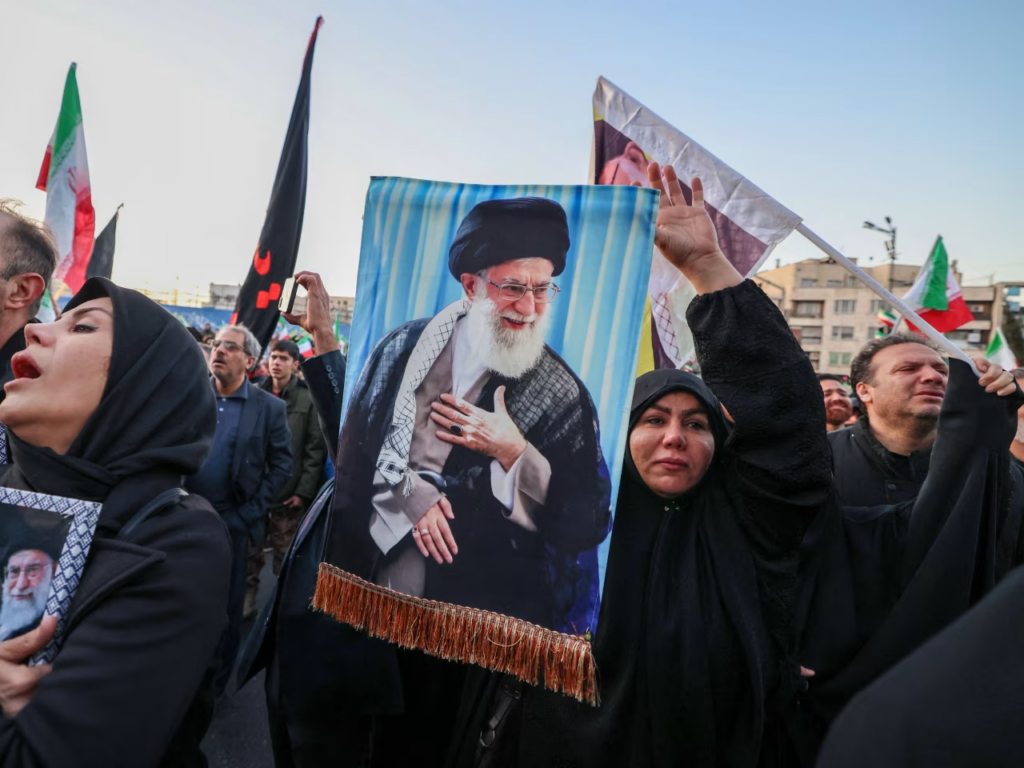
The Islamic Republic of Iran is preparing to bury its late Supreme Leader Ayatollah Ali Khamenei, who was killed in a joint U.S.–Israeli military strike, in the historic city of Mashhad, according to reports by the IRGC‑affiliated Fars News Agency and multiple international outlets. While the exact date and time of the funeral and public memorial have not yet been announced, Iranian authorities are said to be organizing a large farewell ceremony in the capital before the body is transported to Mashhad for burial.
Khamenei — who ruled Iran for 36 years and served as Supreme Leader since 1989 — was reported killed in a major airstrike that also hit other senior regime figures and military commanders. His death has triggered a period of intense political, social, and military reverberations across Iran and the wider Middle East.
According to the Fars report, officials at the headquarters responsible for organizing the official ceremonies are planning a public memorial in Tehran prior to burial. However, no official schedule has yet been confirmed. The decision to delay formal burial rites reflects both the extraordinary security circumstances facing Iran and the complex logistics of staging a high‑profile state funeral amid ongoing conflict.
Mashhad: A City of Religious Significance
Mashhad, located in northeastern Iran, is the country’s second‑largest city and a major center of Shia Islamic pilgrimage. It is home to the Imam Reza shrine, one of the most sacred sites in Shia Islam, and holds deep symbolic meaning for Iranian leadership and religious devotees alike. Fars reported that Khamenei will be laid to rest in Mashhad’s holy grounds, near the shrine where his father, Ayatollah Javad Khamenei, is also buried.
Traditionally, funerals for leaders of such stature in Iran attract large crowds of mourners, religious figures, and political elites. However, authorities are likely to balance ceremonial participation with security concerns amid active hostilities and uncertainty about further escalations. Official reports have indicated that security considerations may even delay some aspects of the burial until after the main funeral ceremonies are completed.
National Mourning and Political Implications
In the immediate aftermath of Khamenei’s death, Iranian state media and officials announced a 40‑day national mourning period, a customary practice that signifies deep respect for the deceased while also uniting the public during periods of transition. The Revolutionary Guard and other state institutions are coordinating mourning activities, state funerals, and memorial events.
The announcement of burial plans occurs against a backdrop of significant political uncertainty. The Assembly of Experts, the clerical body empowered by the Iranian constitution to choose a new Supreme Leader, has reportedly shifted to alternative remote voting methods amid security concerns and military threats that have disrupted regular deliberations. Some reports suggest that the final stages of choosing Khamenei’s successor could be postponed until after his burial.
This transitional period raises complex constitutional and political questions for Iran, particularly as it navigates both internal power dynamics and external pressure. With the Assembly of Experts meeting under unprecedented conditions, Iran’s leadership vacuum has been a focal point for speculation and tension within the region’s diplomatic community.
International Reaction
International media have widely covered the developments surrounding Khamenei’s burial plans. Outlets report that Iran is balancing respect for religious tradition with the practical realities of war and security. The evolving situation has drawn reactions from governments and international organizations, some calling for de‑escalation while others warn of further instability if hostilities continue to spiral.
Regional governments are monitoring burial developments not just as a cultural event but as an indicator of Iran’s internal coherence and political direction. The selection of Mashhad — instead of a purely symbolic burial in Tehran — underscores the regime’s efforts to maintain religious legitimacy and rally public sentiment around his funeral rites.
Legacy of Khamenei and Public Sentiment
Ayatollah Ali Khamenei’s tenure was marked by a consolidation of political and religious authority, expansion of the Islamic Revolutionary Guard Corps (IRGC)’s influence, and a foreign policy that positioned Iran at the center of multiple regional conflicts. His death has elicited a range of public reactions — from state‑approved mourning ceremonies to celebrations among opposition groups.
The upcoming funeral and burial in Mashhad are expected to be deeply significant events in Iran’s modern history — both as a reflection of Khamenei’s decades‑long influence and as a moment of national transition with lasting repercussions for the country’s political future and regional relations.