Fuel storage facility near Iran’s capital erupts in flames after Israeli military targets sites allegedly linked to Iranian armed forces
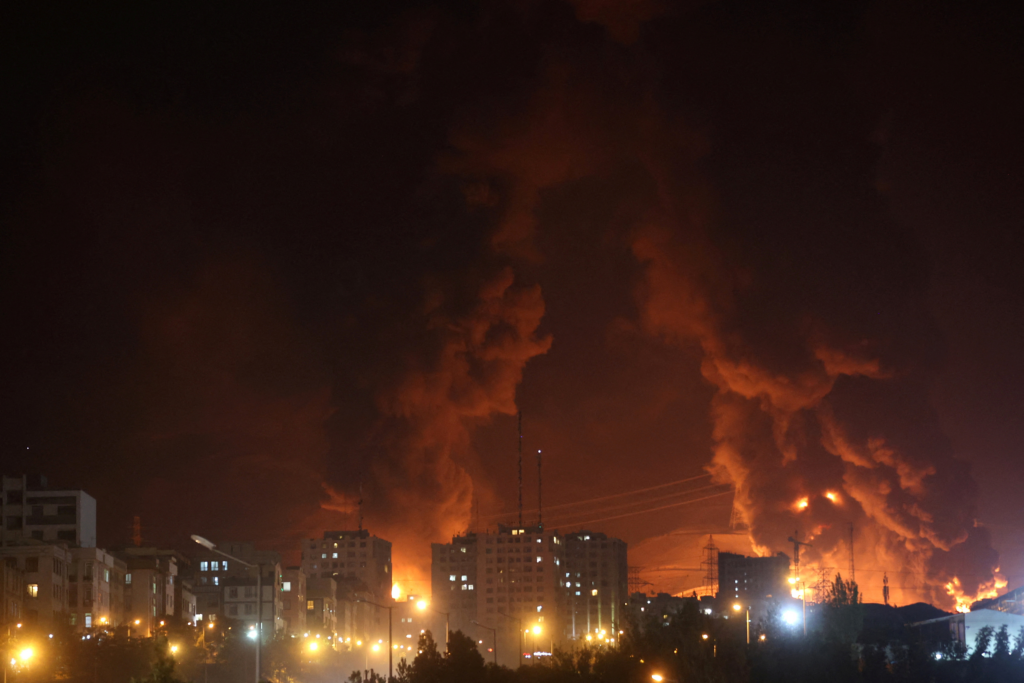
A massive fire erupted at the Shahran Oil Depot on the outskirts of Tehran after an Israeli airstrike late Saturday, marking a significant escalation in the intensifying confrontation between Israel and Iran. Dramatic footage circulating online showed towering flames and thick plumes of smoke rising above the northern part of the Iranian capital as emergency crews attempted to contain the blaze. The Israeli military confirmed that it had targeted fuel storage facilities it alleges are connected to Iran’s military operations.
According to Israeli defense officials, fighter jets carried out precision strikes on several fuel-related sites around Tehran. The targets reportedly included storage depots used to supply fuel to military infrastructure linked to the Islamic Revolutionary Guard Corps (IRGC). Israeli authorities said intelligence assessments indicated the fuel stored at these facilities was being used to support military logistics and operational readiness, making them legitimate targets under wartime strategy.
Videos from the scene revealed a dramatic inferno engulfing parts of the Shahran depot, one of Tehran’s major fuel storage complexes. Witnesses described explosions followed by towering flames that illuminated the night sky across northern districts of the city. Emergency teams and firefighters were deployed to the site to prevent the fire from spreading to nearby residential neighborhoods and additional fuel tanks. Iranian authorities later reported that the situation had been brought under control, though the extent of structural damage remained unclear in the immediate aftermath.
The Shahran facility is considered strategically important for Iran’s capital. Energy analysts note that the depot contains multiple large storage tanks capable of holding several days’ worth of fuel for Tehran’s transportation and power needs. Damage to such infrastructure could disrupt fuel distribution in the metropolitan area, potentially affecting millions of residents and industrial operations. The facility has long been regarded as a key component of the country’s domestic fuel logistics network.
The strike forms part of a broader military campaign by Israel targeting Iranian infrastructure amid a rapidly expanding regional conflict. In recent months, Israeli forces have reportedly carried out operations against a range of Iranian facilities, including nuclear-related sites, military installations, and energy infrastructure believed to support the country’s defense apparatus. These attacks are aimed at weakening Iran’s ability to sustain military operations and project power through allied groups across the Middle East.
Iranian officials strongly condemned the strike, describing it as an act of aggression against national infrastructure and civilian resources. Government statements accused Israel and its allies of escalating the conflict and warned that Tehran would respond decisively to continued attacks on its territory. State media outlets broadcast images of the burning depot while emphasizing the government’s efforts to control the blaze and maintain fuel supplies.
The incident highlights the growing risks posed by attacks on energy infrastructure during wartime. Oil depots and refineries are not only strategic assets but also critical economic lifelines for nations dependent on petroleum production and distribution. Damage to such facilities can disrupt domestic fuel availability, drive up global energy prices, and intensify humanitarian concerns if essential services are affected.
Global markets reacted cautiously to the news of the strike, with analysts warning that further attacks on energy infrastructure could trigger volatility in international oil prices. Iran is among the world’s major energy producers, and any disruption to its supply chain can ripple through global markets. In addition, the possibility of retaliatory strikes targeting shipping routes or oil facilities elsewhere in the region has raised concerns among energy traders and policymakers.
Security experts also note that targeting fuel depots in major cities carries the risk of secondary explosions and environmental damage. Large storage tanks often contain millions of liters of gasoline, diesel, or aviation fuel, making fires extremely difficult to extinguish once ignited. In densely populated urban areas like Tehran, such incidents pose serious risks to nearby communities.
The attack on the Shahran oil depot underscores how the Iran-Israel confrontation has increasingly expanded beyond military bases to include industrial and energy infrastructure. Analysts believe that these strikes are intended to weaken logistical support systems and pressure adversaries economically while avoiding direct occupation or large-scale ground conflict.
As tensions continue to rise across the Middle East, the strike has become another flashpoint in a conflict that shows little sign of easing. With both sides exchanging threats and military actions, international observers warn that further escalation could draw additional regional and global actors into the crisis. For now, the fiery scenes at Tehran’s Shahran depot stand as a stark reminder of how quickly geopolitical rivalries can ignite into destructive confrontations affecting millions of people.