Revolutionary Guards confirm use of advanced ballistic and hypersonic missiles as Iran escalates attacks in the ongoing Middle East war
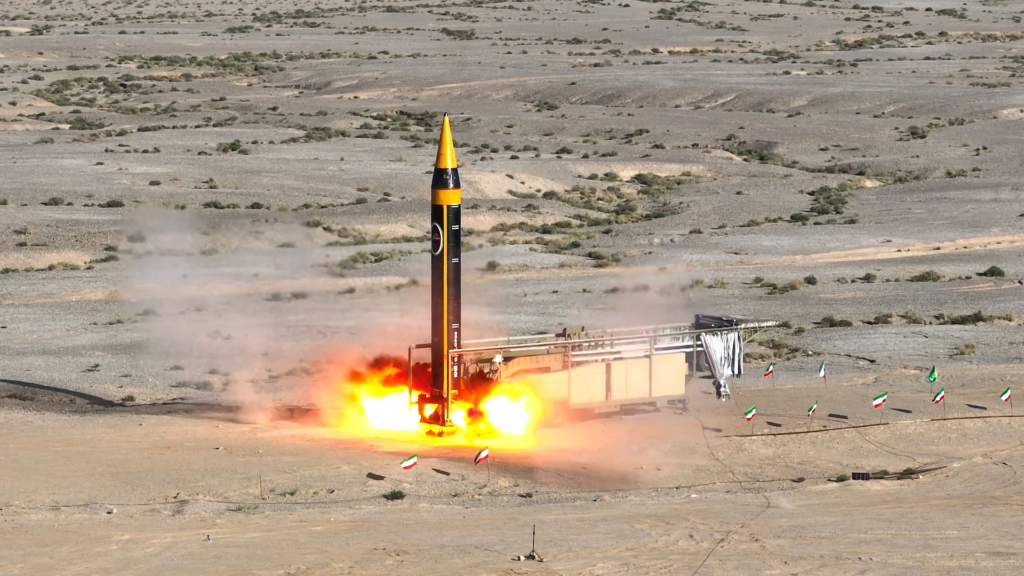
Iran’s Islamic Revolutionary Guard Corps (IRGC) has announced that it deployed some of the most powerful weapons in its missile arsenal — including the Emad, Fattah, and Khaibar missiles — in its latest large-scale strike amid the intensifying war across the Middle East. According to official statements from the Guards, the weapons were used during a fresh barrage of missile launches targeting Israeli positions and U.S.-linked military assets, signaling a major escalation in Tehran’s military response during the ongoing regional conflict.
The announcement comes as the war between Iran, the United States, and Israel continues to expand, with missile and drone exchanges spreading across multiple countries in the region. The IRGC described the missiles as “strategic systems” designed to penetrate advanced air defenses and strike high-value military targets at long distances.
Iran’s Strategic Missile Arsenal in Action
The latest salvo reportedly involved a combination of long-range ballistic missiles and advanced maneuverable weapons. Iranian military officials said the operation aimed at military infrastructure linked to the ongoing airstrikes against Iran.
Among the weapons reportedly used were:
Emad Missile:
The Emad is one of Iran’s most advanced medium-range ballistic missiles. It is believed to have a range of approximately 1,700 kilometers, allowing it to reach targets across the Middle East. The missile features improved guidance systems designed to increase accuracy compared with earlier Iranian missile models.
Fattah Missile:
The Fattah is presented by Iran as a hypersonic missile capable of extremely high speeds and evasive maneuvers. According to Iranian claims, the weapon can travel at speeds approaching Mach 15 and strike targets up to 1,400 kilometers away, although Western analysts have expressed skepticism about the full operational readiness of the system.
Khaibar Missile:
The Khaibar (or Kheibar-Shekan) missile is another powerful ballistic missile developed by Iran’s aerospace forces. Reports indicate that some versions are capable of carrying multiple warheads, allowing them to strike multiple targets or overwhelm missile defense systems.
By combining these different systems in a single operation, Iranian commanders appear to be demonstrating their ability to launch complex missile attacks designed to test and bypass regional defense networks.
Escalation in the 2026 Iran War
The missile strike is part of the broader 2026 Iran war, which erupted after large-scale U.S. and Israeli airstrikes targeted Iranian military infrastructure and leadership earlier this year. The conflict has rapidly expanded into one of the most significant military confrontations in the Middle East in decades.
Since the start of the war, Iran has reportedly launched hundreds of ballistic missiles and thousands of drones against Israeli territory and U.S. military positions across the region.
In response, the United States and Israel have conducted extensive air campaigns targeting Iranian missile bases, naval installations, and military command centers. Analysts say the goal of these strikes is to weaken Iran’s ability to continue launching long-range missile attacks.
Despite the sustained bombardment, Tehran has continued firing missiles and drones in waves, demonstrating that it retains a significant portion of its strategic weapons capability.
Strategic Significance of the Missile Strike
The use of multiple advanced missile types in a single operation carries several strategic implications for the ongoing conflict.
First, it demonstrates Iran’s ability to coordinate complex multi-missile attacks, which could overwhelm missile defense systems such as Israel’s Iron Dome or other regional interception systems.
Second, the deployment of the Fattah hypersonic missile — if operational — represents an attempt by Iran to showcase cutting-edge military technology designed to bypass traditional air defenses.
Third, the combination of different missile types allows Iranian forces to mix speeds, flight paths, and payload capabilities, making it harder for defense systems to intercept incoming projectiles.
Military analysts say these tactics are part of Iran’s broader doctrine of asymmetric warfare, which relies heavily on missile forces and drones to offset the technological advantages of Western air power.
Regional Security Concerns
The latest missile barrage has heightened alarm across the Middle East. Countries in the Gulf region have already been on high alert after Iranian missiles and drones targeted locations in Bahrain, Saudi Arabia, the United Arab Emirates, and Kuwait earlier in the conflict.
Air defense systems across the region have been activated repeatedly in recent days, with several countries reporting successful interceptions of Iranian missiles or drones.
The escalation also raises concerns about potential disruptions to global energy supplies, particularly around the Strait of Hormuz, a narrow shipping lane through which a significant portion of the world’s oil exports passes.
Any prolonged disruption to the waterway could have serious consequences for global energy markets and international trade.
International Reaction
The latest Iranian missile launch has drawn condemnation from Western governments and concern from international organizations. Security experts warn that continued missile exchanges between Iran and its adversaries could push the region closer to a wider war involving additional states.
Diplomatic efforts to de-escalate the conflict remain limited as both sides continue military operations and political rhetoric intensifies.
A Conflict Showing No Signs of Slowing
The IRGC’s confirmation that Emad, Fattah, and Khaibar missiles were used in the latest strike highlights how the war has entered a new phase dominated by long-range missile warfare.
With Iran demonstrating its strategic missile capabilities and the United States and Israel continuing their air campaigns, analysts believe the conflict could remain volatile for weeks or even months.
As the war continues, the use of increasingly powerful weapons raises concerns about both regional stability and the potential humanitarian consequences of prolonged military escalation.